Posted on Leave a comment

Rigger Belt Strength Test

Strength Test Results

In May of this year, we had the opportunity to visit a friend at the New Mexico State University Engineering Dept. He assisted us in conducting several strength tests of two belts. These belts came directly off of our production line. One belt was a our standard rigger belt with an Austrialpin Slide Block Buckle. The second belt tested was our Diamondback Cobra Belt. The NMSU Engineering Dept has a machine that is designed to crush concrete samples to determine tensile strength. This machine will also pull objects apart. It then generates a graph that shows the amount of force that was applied. This machine did not have proper mounting points to run webbing through. In order to test our belts, we had had to improvise mounts using steel bar stock and prusik cord. While testing the standard rigger belt, we had to make a few adjustments to our mounting system. In several instances the prusik cords broke and in one instance the 1/2″ steel bar broke before we could get anything on the belt to fail. Below you will find three short video clips: An introduction, the footage of the belt breaking, and a follow up. To see additional tests as well as some out takes, please visit the Gun Culture page.

[nggallery id=9]

The image above shows the point at which the buckle fails, which is just over 5000 lbs. This is 1000 lbs over the rating stamped on the buckle. This is a 20% safety margin which is fairly standard with life safety equipment. The Type 13 webbing is rated at 7000 lbs. However, when it is in a loop configuration such as a belt, the strength is doubled to 14000 lbs, which is well beyond the limit of the Cobra buckle. We are extremely impressed with the quality products that Austrialpin produces.


Posted on Leave a comment

QD Socket Mod

My bro Ambrosia Terrybone from Instagram gave me this idea for saving some real estate on your carbine. An Mlok QD socket can be stacked on top of a weapon mounted light base. The back side of the socket has some little tabs that need to be removed. You can do this with a flat file or with a belt sander. Then its just a matter of removing the screws on the light base and installing the QD socket.

Posted on Leave a comment

The Spaghetti Western Belt

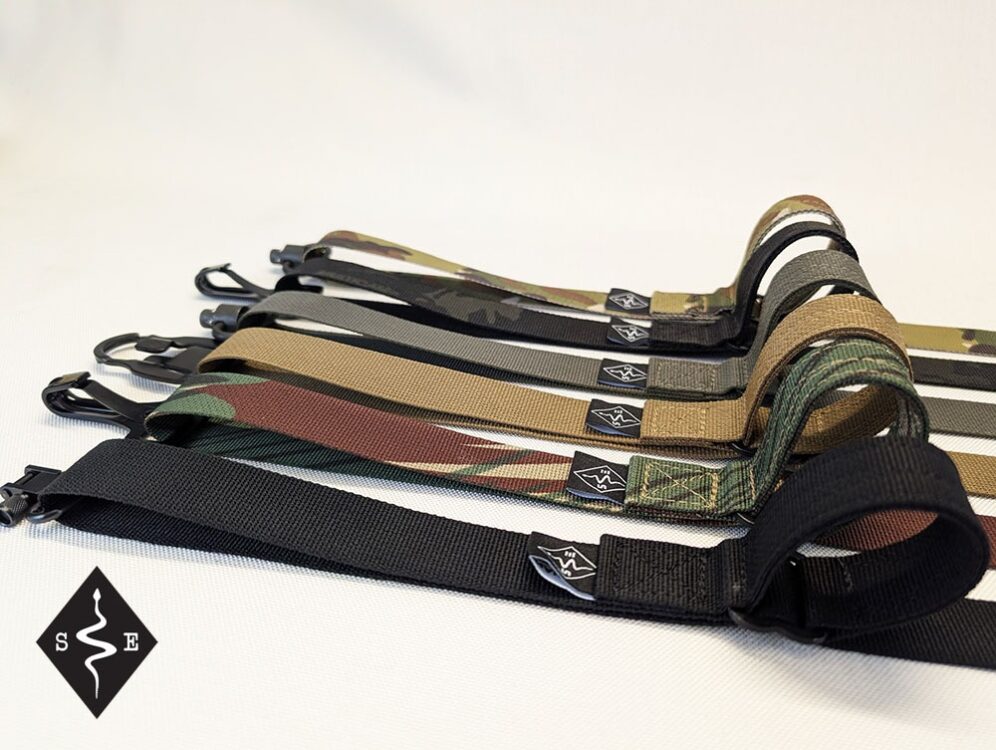
We are pleased to introduce our latest belt, the Spaghetti Western. We took our standard Cobra Belt and added a vintage stitch pattern to it. It is always important to look good, no matter what you are doing, and you will look damn sharp with this belt wrapped around your waist. This belt is as rugged as it is handsome. Made with two layers of resin treated Type 13 webbing, mil-spec hook and loop, and six rows of nylon FF thread running down the length. As an added bonus, the fancy stitch pattern adds a bit more stiffness. And remember, all Cobra Belts are made to order, so you can be sure it will fit perfect. Pick your buckle color, webbing color and even the color of the fancy stitch. The belt pictured below has a Coyote buckle and Coyote thread. This combo looks great on the Black and OD webbing. A Black buckle and Black thread look sharp on the Tan and OD webbing. Be the first guy on the range with this stylish piece of gear!

Posted on Leave a comment

Rigger Belt Strength Test

A few months ago we sent one of our Rigger Belts to the New Mexico State University Engineering Dept. They put our belt on a machine that pulled it apart and then measured the breaking strength. The belt was tested in two different directions. The first test was set up so that one end of the machine went through the 2″ channel behind the buckle. This is channel we leave open for the user to hook a carabiner through, rather than having a heavy steel D-ring. The other end of the machine simply went through the belt. The purpose of this test was to see how strong the channel would be while a user was clipped into it. For the second test the machine was hooked through opposite ends of the belt. The purpose of this test was to determine the overall strength of the belt. The sample belt sent was made from Type 13 webbing, a standard AL9 steel buckle, and our standardized stitch pattern. Below you will find a link to video of the the first test and several documents explaining the results. IMPORTANT NOTE: We do not claim to certify that our belts are rated for life safety. This is simply the result of an independent lab testing the breaking strength of a random production line belt. This test was done so that our customers can get an idea of how strong our belts are. Snake Eater Tactical and Seven Seas Canvas are not responsible for mishaps that occur while using our products.

The following graph shows the results of the first test. At 2768 lbs, the buckle began tearing through the first row of the box-X stitch. The stitch pattern on this belt has an initial three rows of stitching before the box-x starts. The top end of the box-X has an additional three rows of stitching for a total of 6. It took 2768 lbs of force to pull the AL9 buckle through these rows of stitching. From there it took much less force to pull it down through the 5 rows of stitches that run the length of the belt.


Rigger Belt Strength Test 1


This next graph shows the results of the second test. This time the belt held 6655 lbs. max weight. The interesting thing about this test is that nothing actually broke or tore. At the 6655 lbs, the webbing simply began pulling back through the AL9 buckle. When it got to the end the belt, it basically skinned the velcro off. The listed rating of an AL9 buckle is 5000 lbs, so this test shows we have a 1000 lb safety margin.


Rigger Belt Strength Test 2


The conclusion of these tests is that Snake Eater Belts are damn strong. Since this test, we have switched over to using FF nylon thread, which is considerably stronger than polyester. We have also added a 4th row of stitching near the buckle for a total of 7 rows when you include the top of the box-X stitch. In addition, we now sew 6 rows down the length of the belt for maximum strength and stiffness. Our next test will be to pull apart one of our Cobra belts. We are anxious to see how well the Cobra buckle holds up compared to the classic AL9.


Close up of clip in point. Test 1 pulled from this point.


Rigger belt after pull test.


Posted on Leave a comment

Rattlesnake Kabobs

~ 1 rattlesnake, cut into 5 – 8 sections

~ 1 bell pepper, cut into 5 – 8 sections
~ 1 red onion, cut into 5 – 8 sections
~ 1 bottle of A-1 sauce


Place rattlesnake sections onto a metal skewer with bell pepper and red onion sections between each section of snake.

With a brush, generously apply A-1 sauce to snake sections.

Place skewers over an open flame, preferably a campfire.

Cook for about 15 – 20 minutes rotating halfway every 3 – 5 minutes.

Serve and Enjoy!

Posted on Leave a comment

Welcome

Keep up with our blog for the latest news and gun culture from Snake Eater Tactical!